
A Tour of our Micro-Brewery
Real ales available in our shop - click here
Introduction
Our 10 barrel steam brewery came to us via the Wickwar brewery in 2005. After a complete overhaul at a local farm it was moved to the Granary at Langham Lane, Lodsworth — a unique and picturesque barn, specially adapted to our requirements by the skilled builders and craftsmen of the Cowdray Estate. We are a modern brewing operation using traditional methods and finest ingredients to produce our cask conditioned real ales.
This is a brief tour of our brewery explaining how we turn barley, hops and water into real ale.
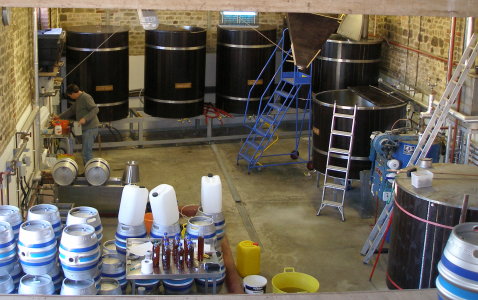
The Hot Liquor Tank
The hot liquor tank is a stainless steel vessel with steam heated coils to heat the brewing liquor up to 70° C. The water is used for the mash and sparging.
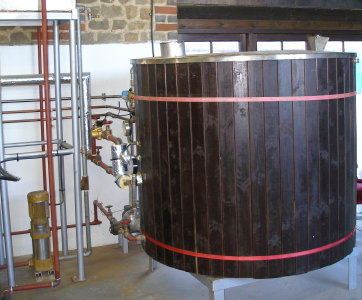
The Mash
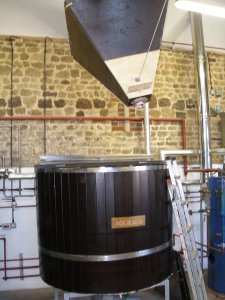
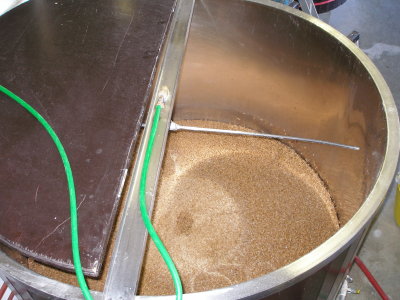
The mash is the first stage of the brewing process. Crushed malted barley is fed from a grist case and mixed with the hot liquor (water) in the mash tun.
The mash tun is an insulated vessel with a slatted false bottom. The grains soak in the hot liquor for an hour in which time the natural enzymes in the malt convert starch from the grains into sugar. The liquid produced is called “sweet wort”.
Sparging
The sweet wort runs out of the mash tun into the underback. To extract the maximum amount of sugars from the grains they are gently sprayed with hot water. This is called sparging. From the underback the wort is pumped to the copper.
The Copper
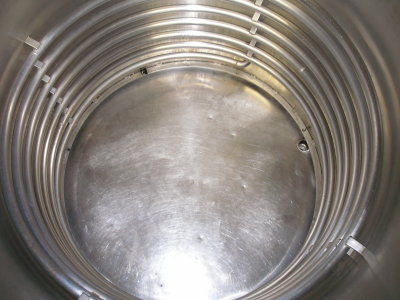
The copper is a big kettle heated by coils with steam flowing through them. Hops are added at the start of the boil for flavouring the beer and the wort is boiled vigourously for 1 to 1½ hours. This not only kills any contaminants, but also extracts flavours and bitterness from the hops. More hops are added towards the end of the boil to give additional aroma and flavour to the beer.
Fermentation
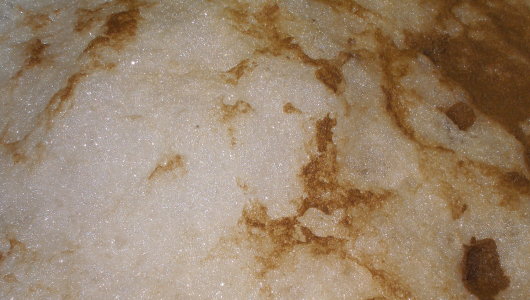
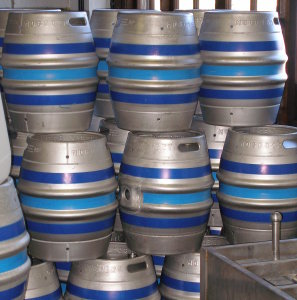
The wort is cooled from boiling to 20° C by pumping it through a heat exchanger and into the fermenting vessel. Yeast is “pitched” or added at this stage and the fermentation begins within the next few hours. The yeast converts the sugars into alcohol, producing carbon dioxide in the process and also a foaming mass of new yeast cells on the surface of the beer, which must be removed. Fermentation takes 3 – 4 days and when it is completed the beer is cooled to 12° C and left to settle. It is then racked into steel casks on the seventh day from pitching the yeast.
Secondary Fermentation
The casks are stored in the cold room at 12° where the fermentation continues. This is known as secondary fermentation. Carbon dioxide is produced dissolved into the liquor and gives the beer a natural measure of condition. This allows the complex and interesting flavours to develop and produces a beer of far more character and taste than non-real ale versions.
The Finished Article
From start to drink the process takes just under two weeks.